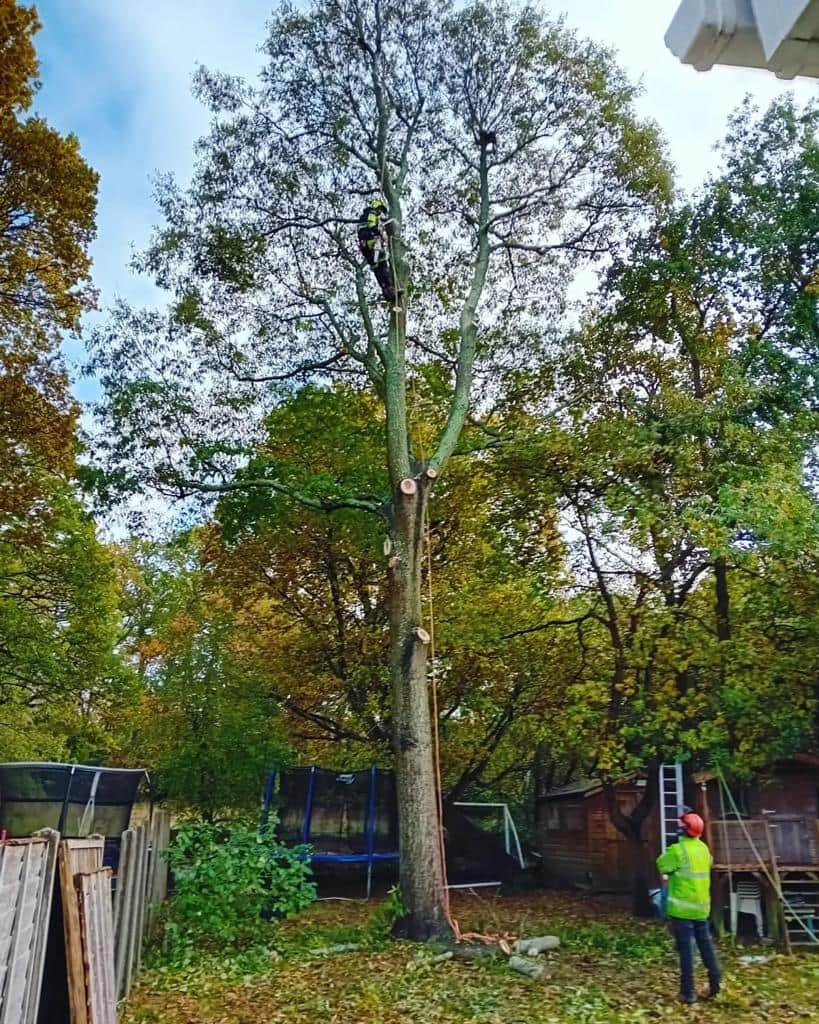
Mature trees can be some of the most established and valuable features within a garden. Their size, branching structure and developed crowns give them considerable presence, but maturity also means that changes can occur over time. Dead branches may develop, individual limbs can become damaged, crowns may become unbalanced, and previous pruning can influence the way new growth forms.
Professional tree surgery can help manage these changes while retaining suitable healthy growth wherever possible. The objective should not be to prune a mature tree simply because it has become large. Instead, tree surgery should respond to identifiable issues involving condition, structure, damaged growth, crown dimensions or the relationship between the tree and its surroundings.
For homeowners in Oxted, Surrey, careful assessment is particularly important before work begins. Mature trees should be considered individually, with the type and extent of tree surgery matched to their current condition rather than relying on unnecessary or excessive pruning.
How Does Professional Tree Surgery Support Mature Tree Management?
Professional tree surgery can improve the condition and structure of mature trees by targeting specific problems while retaining appropriate healthy growth.
Depending on the individual tree, work may involve:
- Removing suitable dead branches
- Managing damaged or broken limbs
- Selectively pruning problematic growth
- Reducing an excessively large crown where appropriate
- Managing disproportionately long branches
- Improving clearance beneath suitable trees
- Addressing particular areas of dense growth
- Managing uneven development
- Responding to regrowth following previous pruning
- Retaining a balanced and appropriate crown
- Planning work around future tree development
The correct approach depends on the tree itself. There is no single pruning method that should automatically be applied to every mature specimen.
Mature Trees Do Not Need Pruning Simply Because They Are Large
Size is a natural characteristic of mature trees.
A substantial crown does not automatically indicate poor condition or a need for reduction.
Where the tree has sufficient space, suitable structure and no particular management issue, extensive pruning may provide little benefit.
Professional tree surgery starts by identifying whether intervention is actually necessary.
This helps avoid removing healthy branches simply to make an established tree smaller without a clear reason.
Assessment Should Come Before Pruning
The most useful tree surgery begins with understanding the tree.
Its crown shape, branch structure, condition and previous pruning history can all influence what work may be appropriate.
The surrounding garden also matters.
A branch that is perfectly suitable in an open part of the crown may become problematic if it extends significantly across a frequently used area.
Assessment allows these factors to be considered together before deciding which branches, if any, require attention.
Deadwood Can Develop Naturally in Mature Trees
As trees mature, some branches may die while the remainder of the crown continues growing.
The presence of individual dead branches does not automatically mean the complete tree is unhealthy.
Where appropriate, deadwood removal can form part of professional tree management.
The work focuses specifically on dead branches rather than unnecessarily reducing healthy sections of the crown.
Separating deadwood management from general pruning helps keep the work proportionate to the actual condition of the tree.
Removing Dead Branches Does Not Require Reducing the Whole Crown
A mature tree containing deadwood may otherwise have a suitable crown.
In this situation, there may be no reason to carry out substantial crown reduction.
Professional tree surgery can focus on the relevant dead branches while leaving appropriate live growth intact.
This distinction is important because different types of tree work have different objectives.
Removing deadwood addresses dead branches. Crown reduction addresses excessive crown dimensions. One does not automatically require the other.
Damaged Branches Can Affect the Structure of the Crown
Branches can become damaged through weather exposure, previous branch failure or other physical influences.
The significance depends on the position and extent of the damage.
Where the problem is confined to one limb, selective tree surgery may be sufficient.
Professional assessment can also consider whether the damage has affected neighbouring growth or altered the balance of the crown.
The objective is to address the damaged section while avoiding unnecessary intervention elsewhere.
Broken Limbs Need to Be Considered in Context
A broken branch can leave an obvious change within a mature tree.
However, the correct response is not necessarily to reduce every surrounding branch to make the crown appear immediately symmetrical.
Trees naturally have irregular structures.
The remaining crown should be assessed according to its condition and branch relationships.
Where additional work is appropriate, it can be targeted to support a suitable overall structure rather than simply creating an artificial shape.
Selective Pruning Can Improve Individual Problem Areas
Not every structural issue involves the complete crown.
Sometimes one branch has become disproportionately long or developed into an inconvenient position.
Selective pruning allows these particular sections to be managed while retaining suitable growth elsewhere.
This can be especially useful with mature trees because it reduces unnecessary intervention.
Rather than treating the entire canopy as a problem, the work remains focused on the branches that actually require management.
Overextended Branches Can Influence Crown Balance
As a tree develops, individual branches may extend significantly further than surrounding growth.
Whether these branches need attention depends on their position, structure and relationship with the rest of the tree.
Where appropriate, selective reduction can manage excessive extension.
The aim should be to retain suitable branch structure rather than simply shortening every long limb by an arbitrary amount.
Professional assessment helps identify appropriate pruning points.
Crown Reduction Can Manage Excessive Dimensions
Crown reduction is a recognised tree surgery technique for situations where the overall dimensions of a crown genuinely require management.
It involves selectively reducing suitable parts of the canopy while maintaining an appropriate overall form.
The technique should not be viewed as simply cutting the entire tree back heavily.
A professional reduction considers branch structure and suitable pruning points.
This can make an established tree more manageable while retaining much of its mature character.
Crown Reduction Is Not Necessary for Every Mature Tree
A tree should not be reduced solely because it has reached a substantial height or spread.
If its dimensions remain suitable for the available space, unnecessary reduction may provide little practical benefit.
Crown reduction is more appropriate when there is a defined reason for changing the dimensions.
The objective may involve managing excessive lateral growth or addressing a crown that has become unsuitable for its particular position.
The reason for the work should determine whether reduction is appropriate.
There Is No Standard Reduction Percentage for Every Tree
Mature trees differ significantly in structure, species, condition and growth habit.
It is therefore inappropriate to assume that every tree should be reduced by exactly the same percentage.
Some may require only minor selective pruning.
Others may benefit from a more noticeable but still proportionate crown reduction.
The amount of work should be guided by the tree and the objective rather than a predetermined figure.
This helps preserve appropriate branch structure and avoids unnecessary pruning.
Crown Thinning Has a Different Purpose
Crown thinning is sometimes confused with crown reduction.
The two techniques are not the same.
Crown reduction changes the external dimensions of the tree.
Crown thinning selectively manages suitable internal growth while generally retaining the overall height and spread of the canopy.
If a mature tree is simply too large for its position, thinning does not necessarily address that problem.
Choosing the correct technique is therefore important.
Crown Thinning Should Be Selective
Removing large amounts of internal growth does not automatically improve a tree.
Where thinning is appropriate, the work should remain selective and purposeful.
The existing crown structure needs to be considered so that unnecessary branches are not removed.
This is particularly important with mature trees where the established canopy has developed over a long period.
Professional tree surgery aims to achieve the intended result without treating every dense-looking section as a defect.
Crown Lifting Can Improve Lower Clearance
Some mature trees have low branches that begin interfering with how the surrounding garden is used.
Where suitable, crown lifting can manage selected lower growth to improve clearance beneath the canopy.
This technique has a different purpose from reducing the overall crown.
The upper parts of the tree can often remain largely unchanged.
Appropriate crown lifting can therefore improve the relationship between the tree and its surroundings without unnecessarily making the complete canopy smaller.
Excessive Crown Lifting Should Be Avoided
Removing too many lower branches can significantly change the appearance and balance of a mature tree.
The amount of lifting should therefore reflect the required clearance and existing structure.
The objective is not to remove every branch below an arbitrary height.
Instead, suitable branches can be considered individually.
This proportionate approach helps retain the established character of the tree while addressing genuine access or clearance issues.
More Pruning Does Not Automatically Mean a Healthier Tree
It is easy to assume that substantial pruning will rejuvenate an established tree.
In reality, healthy branches perform important functions and should not be removed without a reason.
Professional tree surgery is therefore not measured by how much material is taken away.
In some cases, limited selective work may provide greater benefit than a dramatic reduction.
The quality and purpose of the pruning matter more than the volume of branches removed.
Excessive Pruning Can Influence Future Growth
Trees respond to pruning.
Depending on the species and extent of work, heavy cutting can encourage vigorous new shoots.
This can result in dense regrowth around previously pruned sections.
The immediate result may look considerably smaller, but the longer-term response may create additional management requirements.
Professional tree surgery considers how a mature tree is likely to develop after pruning rather than focusing exclusively on its appearance immediately after the work.
Previous Pruning History Matters
Mature trees may have received several different types of work during their lifetime.
Previous pruning can influence current branch structure and growth patterns.
Old cuts may be surrounded by new shoots, or repeated reductions may have created particular areas requiring careful future management.
Understanding this history can help explain why the crown has developed in its current form.
Professional tree surgery can then work with the existing structure rather than ignoring how previous interventions have affected it.
Dense Regrowth May Need Careful Management
Where previous pruning has encouraged numerous new shoots, sections of the crown can become particularly dense.
Simply cutting everything back heavily again may repeat the same cycle.
Selective management may provide a more appropriate approach.
The objective should be to understand how the growth developed and determine which branches should be retained or managed.
This can support a more considered long-term structure.
Mature Trees Naturally Change Over Time
A tree is not a static garden feature.
Branches develop, some sections become more dominant, and occasional branch loss can alter the shape of the canopy.
These changes do not automatically indicate that something is wrong.
Professional tree management distinguishes between normal development and conditions that genuinely require intervention.
This avoids unnecessary pruning while allowing significant structural changes to receive appropriate attention.
Uneven Crowns Are Not Necessarily Poor Crowns
Trees rarely develop into perfectly symmetrical shapes.
Available light, surrounding vegetation, historic branch loss and previous pruning can all influence how the canopy develops.
An uneven crown is therefore not automatically a problem.
Where one section has become disproportionately extended or is creating a specific difficulty, selective management may be appropriate.
The aim should be suitable structure rather than forcing the tree into an artificial symmetrical shape.
Mature Tree Management Should Preserve Suitable Growth
One of the most important principles of professional tree surgery is knowing what should remain.
Healthy, well-positioned branches contribute to the existing crown and future development.
Removing them unnecessarily can reduce the established structure that has taken many years to form.
Good pruning therefore considers the retained canopy just as carefully as the branches selected for removal.
The finished tree should remain appropriate to its condition and surroundings.
Tree Species Influence the Appropriate Approach
Different tree species have different natural forms and growth responses.
Some develop broad spreading crowns, while others naturally grow more upright.
Their responses to pruning can also vary.
This means mature tree surgery should not rely on one standard technique for every tree.
Professional assessment considers the individual specimen before determining the type and extent of work that may be suitable.
Tree Condition Can Change the Pruning Decision
Two mature trees of similar size may require completely different management.
One may have a well-formed crown with only minor deadwood.
Another may contain damaged limbs or problematic regrowth from previous pruning.
Size alone does not reveal these differences.
Assessing condition allows tree surgery to respond to the actual requirements of each tree rather than assuming all mature specimens need similar treatment.
Structural Management Is Not the Same as Making a Tree Smaller
Tree surgery can sometimes improve crown structure without substantially reducing overall dimensions.
Selective pruning may address one poorly positioned or overextended branch while the rest of the canopy remains unchanged.
Likewise, deadwood removal can improve the condition of the crown without changing its general size.
Understanding this distinction helps homeowners choose work based on the tree’s needs rather than viewing all tree surgery as size reduction.
Tree Surgery Can Help Mature Trees Fit Their Surroundings
As trees become larger, the relationship between the crown and surrounding garden can change.
Branches that were once well clear of paths or other outdoor areas may eventually extend into them.
Where the tree remains suitable for retention, targeted management can sometimes restore a more practical relationship.
This might involve selective pruning, crown lifting or proportionate reduction depending on the specific issue.
The aim is to manage the tree rather than unnecessarily remove its established character.
Mature Trees Should Be Considered as Part of the Garden
Tree surgery should not focus only on the canopy in isolation.
The available garden space, nearby planting and how people use the area can influence which work is appropriate.
A low branch may cause no problem in one position but restrict an important route elsewhere.
Similarly, a wide crown may be perfectly suitable where adequate space exists.
Considering the tree in context helps ensure that pruning has a practical purpose.
Tree Surgery Can Support the Retention of Established Trees
When a mature tree develops manageable problems, appropriate tree surgery can sometimes help retain it as an established garden feature.
Selective work may address damaged growth, excessive dimensions or problematic branches without removing the complete tree.
This is particularly valuable where the tree remains suitable for its location.
Tree removal should not automatically be treated as the solution simply because a mature tree requires management.
Mature Size Alone Is Not a Reason for Tree Removal
Large trees can sometimes appear difficult to manage simply because of their scale.
However, size alone does not determine whether a tree should remain.
Its condition, structure, position and relationship with its surroundings provide more meaningful information.
Where problems can be addressed through appropriate tree surgery, retention may remain entirely suitable.
Professional assessment can help distinguish between a manageable mature tree and one where another approach needs consideration.
Pruning Cannot Correct Every Tree Problem
Professional tree surgery has important limitations.
Branch pruning cannot solve every condition affecting a tree.
Problems associated with substantial deterioration or below-ground factors may require a different assessment.
Likewise, reducing the crown should not be used as a general response whenever there is uncertainty about tree condition.
Good tree management includes recognising when pruning will provide a meaningful benefit and when it will not.
Regular Tree Surgery Does Not Mean Heavy Annual Pruning
The idea of regular tree management can sometimes be misunderstood.
It does not mean that every mature tree should receive substantial pruning every year.
Some trees may require little intervention for extended periods.
Regular management is better understood as periodic assessment and carrying out targeted work when there is a clear reason.
This avoids creating unnecessary cycles of cutting and regrowth.
Early Management Can Keep Work More Focused
Allowing problematic branches to become substantially larger can sometimes make future management more complicated.
Periodic assessment may identify overextended or damaged growth while intervention can remain relatively limited.
This does not mean pruning trees prematurely.
Instead, it means responding appropriately when genuine issues begin developing rather than waiting until they dominate the crown.
The Desired Outcome Should Be Clear
Before tree surgery begins, there should be a clear understanding of what the work is intended to achieve.
The objective may be managing a damaged branch, reducing excessive spread, improving lower clearance or addressing particular growth caused by previous pruning.
A defined purpose keeps the work focused.
Without one, mature trees can be pruned generally without producing any meaningful improvement in condition or structure.
Professional Tree Surgery Requires a Proportionate Approach
The best tree surgery is not necessarily the most visually dramatic.
A mature tree may benefit from only a relatively small amount of carefully selected work.
Another may require more extensive crown management.
The important point is that the extent of pruning should match the condition and objective.
A proportionate approach helps preserve suitable healthy growth while addressing the areas that genuinely require attention.
Professional Assessment Helps Determine the Right Service
From ground level, it can be difficult to distinguish between deadwood, damaged growth, dense regrowth and ordinary mature crown development.
Professional assessment can examine these features and determine whether intervention is appropriate.
Where work is required, the correct technique can then be selected.
This may involve deadwood removal, selective pruning, crown reduction, crown lifting or another carefully considered form of tree surgery.
Tree Surgery for Mature Trees in Oxted, Surrey
For homeowners in Oxted, Surrey, mature trees can often be managed successfully through carefully planned tree surgery where intervention is appropriate.
At NS Tree Surgery Oxted, we can assess the tree’s condition, crown structure, previous pruning and relationship with the surrounding garden before recommending suitable work.
Where dead or damaged branches require attention, work can remain focused on those sections. Where individual limbs have become overextended, selective pruning may be appropriate. Where the complete crown genuinely requires management, proportionate crown reduction can be considered.
The aim is to carry out tree surgery that responds to the individual tree rather than removing healthy growth unnecessarily.
Conclusion
Professional tree surgery can improve the health and structure of mature trees by addressing specific problems such as deadwood, damaged branches, excessive crown dimensions, overextended limbs and problematic regrowth.
However, mature trees should not be heavily pruned simply because they are large. Crown reduction, crown lifting, crown thinning and selective pruning all have different purposes, and the correct method depends on the condition and structure of the individual tree.
The most effective approach is proportionate management: retaining suitable healthy growth while addressing branches or crown sections that genuinely require attention. This can help established trees remain manageable and better suited to their surroundings without unnecessary intervention.
If you have mature trees at your property in Oxted, Surrey, and are unsure whether they would benefit from professional attention, contact NS Tree Surgery Oxted. We can assess their current condition and recommend appropriate tree surgery based on their structure, growth and surroundings.
Call us on: 01883 771 495
Click here to find out more about NS Tree Surgery Oxted
Click here to complete our contact form and see how we can help with your tree needs.